

Leatherneck Legends
The ‘Banana Wars’ were occupations, police actions and interventions on the part of the United States in Central America and the Caribbean between the end of the Spanish American War in 1898 and the inception of the Good Neighbor Policy in 1934. These military interventions were mostly often carried out by the United States Marine Corps.
The term “Banana Wars” was coined much later to cast the motivations for these interventions as almost exclusively the preservation of U.S. commercial interests in the region. Most prominently, the US was advancing its economic, political, and military interests to maintain its sphere of influence and securing the Panama Canal (opened in 1914) which it had recently built to promote global trade and to project its own naval power. US companies such as the United Fruit Company also had financial stakes in the production of bananas, tobacco, sugar cane, and other commodities throughout the Caribbean, Central America and the northern part of South America.
In 1909 Nicaraguan President José Santos Zelaya of the Liberal Party faced opposition from the Conservative Party, led by Governor Juan José Estrada who received support from the U.S. government. The United States had limited military presence in Nicaragua at the time, having only one patrolling U.S. Navy ship off the coast, in order to protect the lives and interests of American citizens who lived there. The Conservative Party sought to overthrow Zelaya which led to Estrada’s rebellion in December 1909. Two Americans, Leonard Groce ‘and Lee Roy Cannon, were captured and indicted for allegedly joining the rebellion and the laying of mines. Zelaya ordered the execution of the two Americans, which severed U.S. relations and instigated a military response.
Perhaps the single most active military officer in the Banana Wars was U.S. Marine Corps Major General, Smedley Butler, nicknamed ‘Maverick Marine’, who saw action in Honduras in 1903, served in Nicaragua enforcing American policy from 1909 to 1912 and would later be awarded two Medal of Honors, one for his actions in Veracruz in 1914 and the other for bravery in Haiti in 1915.
On May 27, 1910, Smedley Butler, who was a major at the time, arrived off the coast of Nicaragua with 250 Marines. One of them was a young Corporal Puller who was eager for combat. Another notable Marine who served during this time period was Corporal Lewis Burwell ‘Chesty’ Puller. Some say Puller got his famous nickname because of his big, thrust-out chest; the myth was that the original had been shot away and the new chest was a steel plate. Others state that “Chesty” was an old Marine expression meaning cocky. He approached Major Butler while they were still aboard the naval vessel, Albany. “Excuse me sir,”
“What is it Corporal Puller?” Major Butler responded impatiently as he smoked a cigar on deck and enjoyed the majestic beauty of a star-filled night and most of all, a few moments of solitude.
“I would like to volunteer for any combat missions as soon as we go ashore.”
“Would you say that you’re a Marine that is aware of his surroundings and can assess situations in an intelligent manner?” Major Butler inquired.
“Yes sir, I’m your man,” Corporal Puller responded without hesitation.
“Think about this question very carefully. When you see your superior officer standing off by himself enjoying his cigar and it isn’t military business, an emergency or a life and death situation, what do you do?”
“Leave him alone,” Corporal Puller hung his head and whispered.
“That’s the kind of assessment that I expect from my Marines,” Major Butler growled, “One more thing I’m not in the business of granting personal wishes. You save those for your birthday and the good fairy.”
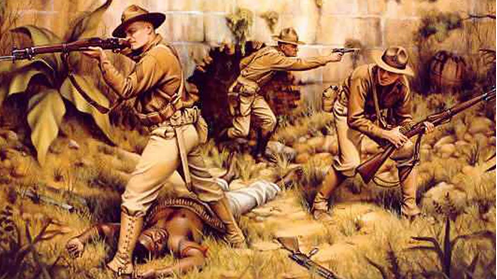
The Albany docked at Puerto Cabezas, Nicaragua and the khaki-clad Marines disembarked and marched to the railroad station where they boarded flat cars and boxcars for the 231 miles trip to Masaya. As the train slowly rolled out, 100 rebels rode alongside the train in the dark, firing at the Marines. Major Butler yelled out, “Return fire!”
A barrage of bullets also came from surrounding windows and rooftops as the locomotive picked up speed. There were so many muzzle flashes in the darkness that it looked like streams of flames piercing the night. The sixteen machine guns of the Marines played a staccato beat as they riddled the area.
When one machine gun was taken out by the rebels, Corporal Puller called out, “Aldrich, Lucas, follow me!” The three Marines ran through enemy fire to reach the machine gun, took control and began firing at the rebels. Puller leaped from the flatcar and landed on the back of the horse as a rebel rode by, stabbed him and threw him off. Riding among the rebels, Puller began firing at them, sometimes as close as two feet. When the battle was over, Major Butler turned to his executive officer, Captain Vandergrift, “Not exactly the kind of welcome that I hoped for, but I’m not surprised.” Butler saw Corporal Puller riding a big white horse and called out, “Did you get the action you wanted, Corporal? Be careful what you wish for, you might not like it when you get it.”
“Yes sir, I’ll remember that,” Chesty Puller smiled.
This action took place on September 19, 1912, mission that would later be known as the first Nicaraguan battle. Three days later on September 22, Major Butler stopped outside the town of Granada where his unit met up with Colonel Joseph Pendleton, “Hey Smed, how’s life treating you?
“You know how it is when you’re a Marine in a foreign country, you never know who wants to kill you,” Major Butler smiled.
“Keep your head on a swivel,” Colonel Pendleton warned, “We should send out a scouting patrol to see what we’re up against.”
“I know just the man to lead, Puller, front and center!” Major Butler called out
Puller came rushing up, “Yes sir.”
“I need you to recon the area. Take two men and see what type of fortifications the enemy has and report back. Avoid contact, I don’t want them knowing we’re here.”
“Yes sir.”
With the information that Sergeant Puller provided from his reconnaissance patrol, Butler and Pendleton were able to develop a plan and capture Granada without suffering any casualties. On September 26th General Mena, the primary instigator of the failed coup d’état surrendered his 700 troops to American Rear Admiral Henry Southerland. Some of the rebels refused to give up so Nicaraguan government forces bombarded Barranca and Coyotepe, the two hills that overlooked the all-important railway line at Masaya.
On October 2, the Nicaraguan government delivered a surrender ultimatum to Zeledón, the rebel leader. He responded with a note, ‘Come and get me’ and sent it back with the severed head of a Nicaraguan soldier.
Rear Admiral Southerland realized that Nicaraguan government forces would not be able to vanquish the insurgents by bombardment alone, so he ordered the Marine commanders to assault the hills. “Well Marines, I guess we got our answer. Zeledon has made it very clear that he wants a fight and our heads on a stick.”
Major Butler grinned, “There’s a big difference between wanting a fight and winning one.”
“We’ve got leathernecks and our heads don’t pop off that easy.” Colonel Pendleton quipped.
On October 3rd, Major Butler and his men began moving up Coyotepe, the higher hill to converge with Pendleton’s 600 Marines who were moving up Barranca. When the Marines got to the summit, they seized the rebel’s artillery. Sergeant Puller and his squad engaged a group of ill- advised rebels in hand-to-hand combat and killed eleven of them and captured three more. Zeledon and his remaining troops had fled the previous day during the bombardment, much to the disappointment of the Marines.
“I guess Zeledon is better at running then he is at fighting,” Butler commented as he sat down on a rock and took a long swallow of water from his canteen.
Pendleton took a bite of beef jerky and replied, “He’s going to continue to cause trouble, you know that?”
“I know, let our men rest for a while then we’ll get back at it,” Major Butler sighed.
Sergeant Puller arrived with a young Nicaraguan girl and three horse drawn carts filled with bananas and several large coolers. “Excuse me, sirs, this is Maria Cabellon, she wanted to thank us for driving off Zeledon and his men. He killed her grandfather.”
“Glad to be of service,” Major Butler smiled.
“She brought us something,” Puller opened the metal coolers to expose gallons of homemade ice cream.
Maria sliced the bananas down the middle and placed scoops of ice cream over it, then added fruit toppings and passed bowls out to the hot and appreciative Marines. Some say that this was the birthday of the banana split.
Two days later, Butler and Pendleton met up with Lieutenant Colonel Charles Long and the three Marines officers and their Marines attacked the town of Leon, the last stronghold of the insurgency. It was during this battle that Sergeant Puller captured the elusive General Diaz. Six heavily armed rebels were protecting the rebel leader, but they did not deter the fearless Marine who rushed headlong in harm’s way. Puller blew the lock off the door with a blast from a 12-gauge shotgun, kicked it down and rushed in. In a matter of seconds, those six men were lying dead and General Diaz had his hands in the air “You Marines are mucho hombres.”
Corporal Short came rushing up with a platoon of leathernecks, “Damn it Puller, if you’re going to fight this war by yourself, you might as well let us go into town and get drunk.”
“Bring me back a bottle,” Puller laughed.
On October 23, 1912, The Marines left Nicaragua having accomplished their mission in the highest tradition of the best fighting force in the world. Sergeant Puller received the Navy Cross for his actions ad also received a battlefield commission to first lieutenant. By the time the Marines were sent to Haiti by President Woodrow Wilson in 1915, Puller had risen to the rank of Captain and Major Butler made Colonel before being demoted back down to Major by being a Maverick and disobeying orders.
“If you keep getting busted, I’m going to outrank you,” Captain Puller joked.
“You’ll probably be dead before that ever happens,” Major Butler grumbled.
Before the Maverick Marine and Chesty could continue their bantering, Boxer Rebellion veteran and Medal of Honor recipient, Sergeant Dan Daly entered the tent and commented, “We’re Marines, do you want to live forever!”
“Danny Boy!” Good to see you!” Major Butler introduced the grizzled veteran to the brash Captain Puller, “Puller, this is the fightinest Marine in the Corps.”
“I’ve heard about you, Captain Puller,” Dan Daly spit out the words, “I’m not a big fan of officers, never was and never will be, Major Butler will tell you that.”
“Salute when you approach a superior officer?” Captain Puller stood face to face with the Marine legend, waiting for an answer.
“I heard you were a cocky s.o.b, Captain Chesty?” Dan Daly rendered a crisp salute, “Good morning, sir, I’ll have wait and see if I hate you as much as I do Smedley.”
Major Butler stood back in amazement, “This is going to get real interesting, real soon. Let’s go kill us some bad guys before we kill each other.”
On 24 October 1915, Major Smedley Butler was in command of a mounted reconnaissance patrol south of Fort Liberte, Haiti, near the enemy-held Fort Dipitie. While fording the Grande River at night, a force of more than 400 rifle-armed Cacos (rebel Haitians) attacked the Marines from three distinct positions. The Americans and retreated to high ground a few hundred yards to their rear to regroup.
During the retreat, the Marines lost their only machine gun when a Caco rifleman shot the two men carrying it. Dan Daly retrieved the machine gun and killed three Cacos with his knife in the process. He would be awarded his second Medal of Honor for this action. The Cacos followed up their ambush and attacked the Marines several times during the night, but the Americans valiantly held their ground. Seventy-five Cacos were killed and one Marine was wounded during the two-day battle.
Major Butler finally got tired of being on the defense and told his Marines, “These guys are getting on my nerves. We attack at first light and if it’s not a Marine, shoot it. If it’s still moving then shoot it again.”
As soon as the sun showed its face on the horizon, the Marines divided into three groups and ran as fast as they could toward the river and the main body of the enemy. The Cacos escaped to Fort Dipitie and the Marines then attacked that structure and captured it. Captain Puller and Sergeant Daly were the first inside the gate as Major Butler coordinated the attack. A few days later, these same Marines went on to their next objective, Fort Rivere.
Confident that his force could capture the fort, Smedley Butler prepared his men for battle at 1900 hours. He turned to Captain Puller and Sergeant Daly, “I’ll be leading this mission, which means that you two follow me, not the other way around understood?”
“Yes sir,” Captain Puller mumbled.
“Copy that,” Sergeant Daly growled.
An assault was launched against the northern wall and Butler. Puller and Daly and twenty-three Marines used this diversion to advance to the southern side where a small tunnel led into the fortification. When they exited the tunnel, they opened fire on the Cacos and engaged in hand-to-hand combat with them. Sergeant Daly shot two enemy fighters and opened the gate for the other Marines to enter. When he ran out of ammunition, Captain Puller began threw large stones at the Cacos until Major Butler tossed him a rifle, “Use this, hardcase.”
Some of the enemy fighters were so afraid of the Marines and their ferocity in battle that they preferred to jump to their deaths off the western side of the fort which was100 feet high. The battle lasted twenty minutes and when the smoke had cleared, 50 Cacos were lying dead. With Fort Rivière taken, the First Caco War came to an end as the Haitian rebels no longer held any more ground. Two weeks later, the three combat hardened veterans were eating ice cream with bananas in Port au Prince, Haiti, like three kids at a party, laughing and joking with each other. “This is the life,” Captain Puller flicked a spoonful of ice cream into Major Butler’s eye.
“I’ll consider that a declaration a war,” Major Butler responded in kind.
Smedley Butler was awarded two Medal of Honors as was Dan Daly and Lewis Puller went on to receive five Navy Crosses. When they reminisced about their numerous military exploits, the the Banana Split Wars were at the top of the list forthe Leatherneck Legends.
The End



Quite the historical saga here. I cannot imagine anyone associated with the US military not at least knowing of the name Chesty Puller! You certainly honored him and the Marine Corps. I am not at all familiar with the history of the Caribbean, but I am guessing that the Cacos are the basis for the Caicos of Turks and Caicos. Thanks for the great history lesson!
Another bang up story about Marines and defending our country and the interests of our country. Last week Mr. Calabrese wrote about Ensign Wyatt and his encounter with the “Duke” (John Wayne). All novels but very entertaining and suitable for all ages.
Mr. Calabrese has the knack of injecting historical fact and people and molding it into a great story for your pleasure. This Sunday’s Vista Press story is no different with the exception that Mr. Calabrese has some of the most famous Marines in history take part in his story. Legends of the Corps and history. wonderful story and a great way to start your Sunday. Thank you Mr. calabrese.
Tom, once again you made my day. This is made for movie with Clint Eastwood, but since he is a little tool old now not sure who could fill the bill of these 3 Marines.
Semper Fi